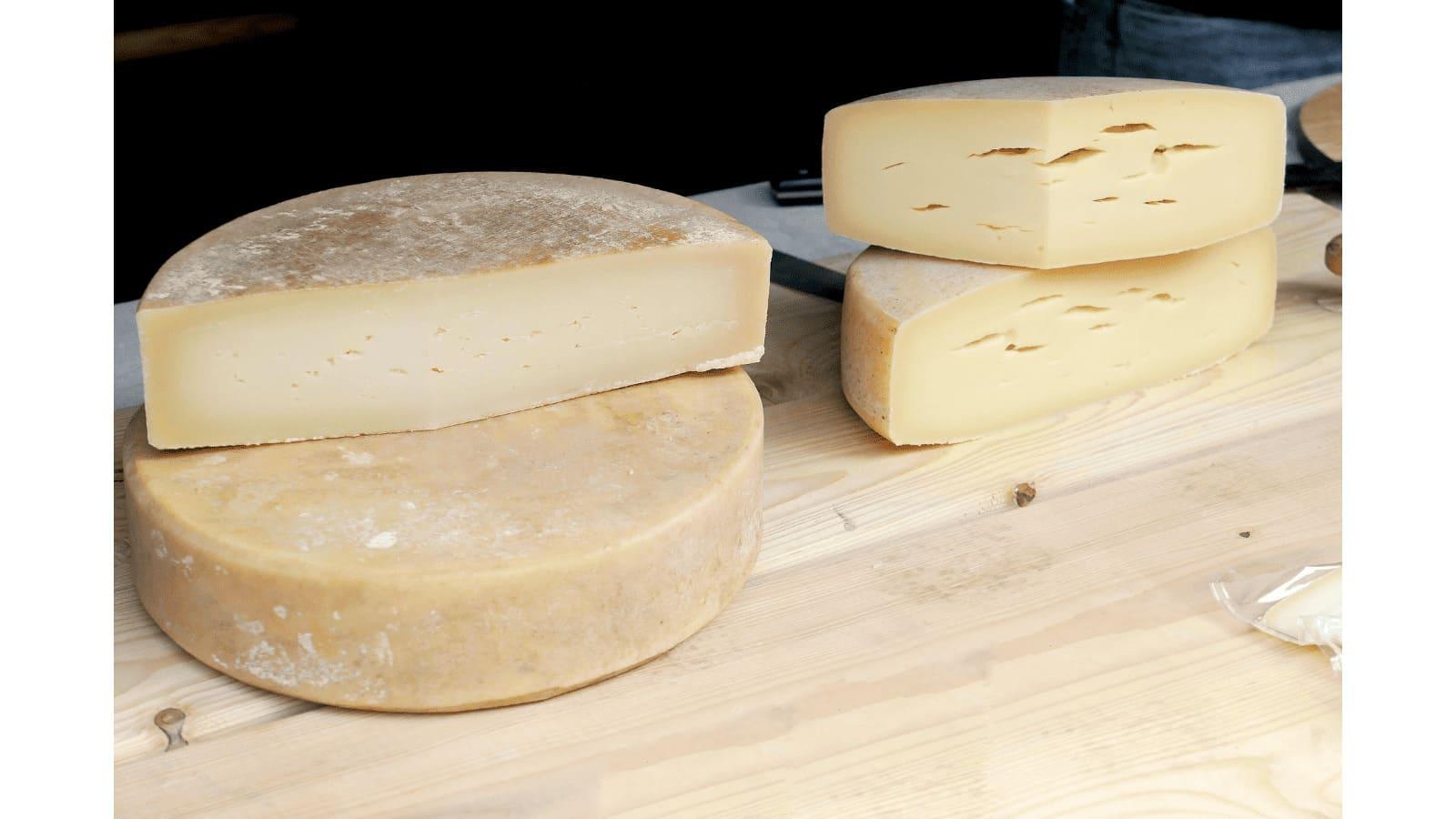
Secrets of Abondance AOP Cheese: the story, the craft and the flavours of a Savoyard treasure
Some cheeses tell a story. Not just the story of a craft or a recipe handed down through generations, but the story of an entire landscape, a breed of cattle, a human community. Abondance AOP cheese is one of those cheeses. Born in the heart of the Abondance valley, deep within the Chablais massif in Haute-Savoie, every wheel carries centuries of pastoral tradition, artisanal rigour and mountain generosity. Here are the secrets of this exceptional cheese and why a visit to Abondance would not be complete without savouring a beautiful slice.
A story stretching back centuries
To understand Abondance cheese, you need to go back to the Middle Ages, more precisely to the 13th century. It was under the impetus of the canons of Abondance Abbey that this cheese truly came into being. These monks, settled in the valley, not only cleared the high alpine pastures and developed cattle farming, but also perfected the cheesemaking techniques that are still in use today.
The cheese's reputation quickly spread beyond the valley's borders, reaching the tables of European royal courts. It is even said to have been served at the great Council of Constance in the 15th century, an early sign of its prestige.
Over the centuries, the craft was passed from farm to farm, from alp to alp, carried by farming families who built their identity around this cheese. But in the 20th century, the mechanisation and industrialisation of the dairy sector threatened its survival. By the 1970s, Abondance production was in serious decline. It was the mobilisation of local producers and the creation of an organised industry body that saved this heritage. In 1990, Abondance cheese was awarded its Appellation d'Origine Contrôlée (AOC), followed in 1996 by its European Appellation d'Origine Protégée (AOP), a double recognition that today guarantees both its territorial roots and the quality of its production.
An exceptional terroir: the Abondance valley and the Chablais
Abondance AOP cheese can only be produced within a precise geographical area: the mountainous massifs of Haute-Savoie, stretching from the Abondance valley to the Aravis range via the Mont-Blanc country. This territory, situated in the Chablais, the north-eastern part of Haute-Savoie between Lake Geneva and the Giffre valley, offers quite exceptional natural conditions for cheesemaking.
The altitude, ranging from 900 to 2,500 metres, nurtures an extraordinarily rich alpine flora: hundreds of species of flowers, grasses and aromatic herbs that the cows graze freely from June to September on the high mountain pastures. This botanical biodiversity expresses itself directly in the milk, and then in the cheese. The floral, fruity and subtly nutty aromas that characterise Abondance are the direct expression of what the cows eat on these altitude pastures.
Cheeses produced in summer, after the cattle have moved up to the mountain pastures, have a different flavour profile from those made in winter, when the cows' diet is supplemented with hay. This natural variability is a richness, the hallmark of a living cheese, rooted in the seasons.
The Abondance cow: a breed at the heart of the cheese
Abondance cheese takes its name from the valley where it was born, but also from the breed of cattle that provides its milk: the Abondance cow. It is one of the rare cheeses in the world to share its name with the animal that produces it and the territory that nurtures it, a unique trinity that speaks to the deep identity of this cheese.
The Abondance is a sturdy mountain cow, robustly built and perfectly adapted to the demands of alpine life. Recognisable by its fawn coat with chestnut patches around the eyes, earning it the affectionate nickname of « lunettes », it has been selectively bred for centuries for the quality rather than the quantity of its milk. The result is a rich, creamy, fragrant milk that is the ideal raw material for a cheese with real character.
The AOP specifications also permit the use of milk from two other Savoyard breeds: the Montbéliarde and the Tarine (or Tarentaise). But it is the Abondance cow that remains central to the cheese's identity and that gives the milk its most distinctive flavour characteristics.
On average, 10 litres of this raw milk are needed to produce just 1 kilogram of Abondance cheese, a ratio that speaks volumes about the concentration of flavour in every wheel.
From milking to cellar: the secrets of production
The production of Abondance cheese is a rigorous process, faithful to ancestral gestures and governed by a precise set of specifications. Each step contributes to building the unique character of this cheese.
Milk collection is a daily affair. To preserve the natural ferments present in the raw milk, those responsible for the microbiological richness of the cheese and its complex aromas — the time between milking and cheesemaking is kept to a minimum. The evening and morning milkings are combined in large copper vats, heated to 32°C for renneting.
Curdling is triggered by the addition of natural rennet, which causes the milk to coagulate. The curd is then cut using a curd knife into small grains ranging in size from a grain of rice to a grain of maize, a step that requires both precision and experience.
Heating and stirring: the curd is stirred, heated a second time to 48°C, this is what makes Abondance a semi-cooked pressed cheese, then is stirred again. The crucial moment is knowing when to stop: the grains should squeak under the cheesemaker's finger, a sign that they have reached the ideal texture.
Drawing off the curd is one of the most physically demanding and emblematic steps in farmhouse production. The cheesemaker plunges their arms into the scalding vat, wrapped in a linen cloth, to scoop out the curd grains suspended in the whey. An ancestral gesture that requires strength, skill and endurance.
Moulding and pressing: the curd is immediately placed in a metal hoop that gives it its characteristic shape. It is at this precise moment that the casein identification plate is applied, green and oval for farmhouse cheeses, red and square for dairy cheeses. The wheels are then mechanically pressed for 24 hours, before being immersed in a brine bath for salting.
Affinage, the ageing process is the final and no less essential step. The wheels are placed in the ageing cellar on unsanded spruce boards, in a regulated atmosphere of between 10°C and 13°C, with 90% humidity. They are regularly rubbed with morge (a mixture of water and salt) and turned to ensure even maturation. The minimum ageing period is 100 days, just over three months but the most carefully matured wheels remain in the cellar for up to six months, developing more intense flavours and a firmer texture. It is during this period that the beautiful amber rind forms, with its characteristic cloth markings, the visual signature of Abondance cheese.
Farmhouse or dairy: how to tell the difference?
Abondance AOP cheese comes in two forms, each with its own characteristics.
Farmhouse Abondance (fermier) is produced and made on the farm, using only the milk from that farm's own herd. Many operations remain manual. It accounts for roughly a third of total production, around 950 tonnes a year and around sixty farmhouse producers continue this tradition. Its casein plate is green and oval.
Dairy Abondance (laitier) is made in a creamery or cooperative, using milk collected from several different farms. Production is larger, around 2,860 tonnes a year, spread across 13 processing facilities. Its casein plate is red and square.
Both carry the AOP designation and comply with the same production specifications. The difference lies primarily in the diversity of milks used and the production conditions: farmhouse Abondance expresses the terroir of a single farm, while dairy Abondance blends the milk of several producers for greater consistency.
The industry as a whole brings together 175 milk producers for a total output of around 3,800 tonnes a year, a healthy figure for a mountain cheese that came close to disappearing half a century ago.
A cheese of many flavours: how to enjoy it
Abondance cheese is presented as a flat cylindrical wheel, 40 cm in diameter, with a concave heel that slightly inward-curving edge is one of the distinctive signs of its production. Weight varies from 6 to 12 kilograms depending on the wheel.
The paste, ivory to pale yellow in colour, is supple and melt-in-the-mouth. The amber rind, marked by the folds of the cloth, releases intense aromas. As for the flavour, it is both fruity and floral, with subtle notes of hazelnut, sometimes pineapple or citrus, aromas that vary according to the season of production and the length of ageing.
Its peak season runs from June to December, when the wheels made from the spring and summer alpine milk reach full maturity.
On a cheeseboard, it stands on its own, accompanied by a good country bread and a white Savoie wine, a Roussette de Savoie, a Crépy or a Savoyard Chardonnay all pair beautifully.
In cooking, Abondance reveals other dimensions. It is of course superb in a Savoyard fondue or a raclette, where its melting paste and fruity aromas add real depth. But it is in the Berthoud that it truly comes into its own.
The Berthoud: the emblematic dish of Abondance cheese
The Berthoud deserves special attention, for it is one of the great gastronomic specialities of the Chablais and the first recipe in France to be protected by the European Traditional Speciality Guaranteed (TSG) label, awarded in 2020.
Its story is as flavourful as the dish itself. In the early 20th century, at the Cercle Républicain, a bistro in Thonon-les-Bains run by the Berthoud family, who were originally from the commune of Abondance, customers enjoyed a simple dish: Abondance cheese melted with garlic, white wine and pepper, served in a small ceramic dish. The dish took the family's name, and its reputation spread well beyond the Chablais.
The traditional recipe is disarmingly simple: rub an individual porcelain dish with a clove of garlic, lay in 180 grams of Abondance cut into thin slices, pour over a splash of Savoie white wine and a dash of Madeira or Port, season generously with pepper, and brown in the oven at 180 to 200°C for around ten minutes. Serve piping hot, with bread, jacket potatoes and Savoyard charcuterie.
Simple, generous, convivial, the Berthoud perfectly embodies the spirit of mountain gastronomy.
Where to discover and taste Abondance in the valley
Staying in Abondance means having the rare privilege of discovering this cheese on its home territory, where it was born and where it continues to be made with passion.
Several farms and creameries in the valley welcome visitors and offer the chance to see Abondance cheese being made up close. It is a memorable experience to watch the cheesemaker plunge their arms into the steaming vat, or to breathe in the aromas of the ageing cellar lined with golden wheels.
At local markets and in the village shops, you will find both farmhouse and dairy Abondance at every stage of maturity. Do not hesitate to ask for advice, the producers and cheesemongers of the valley are always delighted to share their passion and help you choose the wheel that suits your taste.
And if you would like to take a little piece of the valley home with you, a well-aged slice of Abondance, carefully wrapped, will travel perfectly. A gift from the terroir that is sure to delight.
At Hôtel Les Touristes, Sabrina and her team will be happy to recommend the best addresses for buying, tasting and discovering Abondance cheese during your stay in the valley. Because understanding the secrets of this exceptional cheese also means better understanding and better loving, the territory that gave it life.
Enjoy, and see you soon in Abondance!
The Les Touristes Team
Planning a stay in the Abondance valley to discover its cheeses, its alpine pastures and its Savoyard terroir? Book directly at Hôtel Les Touristes, right in the heart of the village.